
Thanks to the work of the Eatonville Main Street Association, the Eatonville Historic Walking Tour is complete and available for all to experience and share with others. Leading the charge and coordinating the tour’s development is longtime Eatonville resident and avid historian Bob Walter.
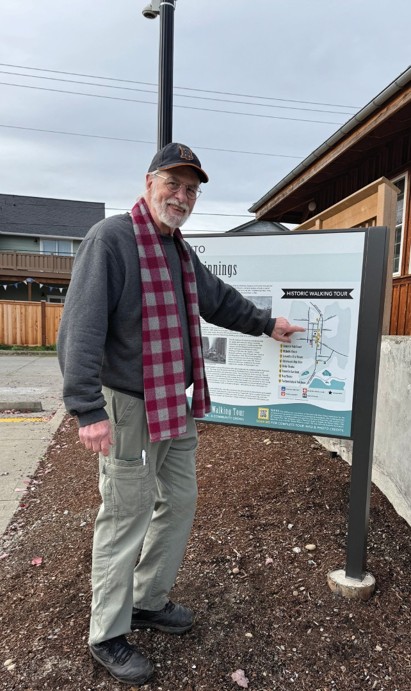
Eatonville’s Historic Walking Tour features nine information signs along Mashell Avenue. The downtown tour loop is about a half-mile round-trip, and visiting stop number eight—Mill Pond Park—adds another half-mile round-trip. The stops are not sequential, so visitors can take whichever path they please. Also, each sign has a QR code directing visitors to more local history.
“It offers visitors and locals alike to step back in time, experience the town in its early days and learn how the original main street has evolved,” Bob says. “The historic walk tries to incorporate all aspects of the town’s colorful history.”
The stops pay homage to Indigenous people with traditions going back more than a
millennium, the area’s robust logging industry, the impact of the railroad and Mount Rainier, and the town’s incorporation in 1909.
A map featuring a brief explanation of the tour is available at the starting point: the visitor center on Mashell Avenue.
“The trifold map will help you not only find each stop along the tour, it also shares a brief history for each stop,” he says.
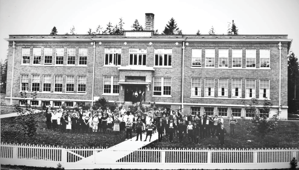
The current high school was dedicated in 1914. Many of the maple trees planted back then still line the street. While the original school mascot was the Mountaineers, the student body changed the name to Cruisers in 1926.
This historic structure has been a fixture in Eatonville since it was dedicated in 1912. The ornate Blymyer bell was added to the belfry two years later.
Throughout the years, the church has served as a gathering place for a variety of classes, musical events and, for a while, the town library.
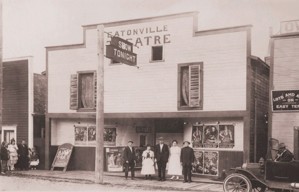
One of Eatonville’s most versatile commercial buildings, this structure first opened as a theater in 1915. Since this was the silent film era, a local pianist played music to accompany the silent films.
After the opening of the Roxy Theatre (Stop 7), Eatonville’s first movie theater went on to accommodate a variety of groups and businesses including a Pentecostal church, the Fraternal Order of Eagles and Bertram’s Upholstery.
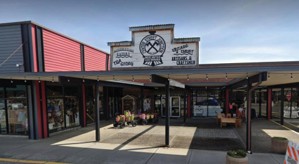
In 1936, local businessman Nels C. Christensen made a property trade with the Cushman family and moved directly across the street to this location, expanding his growing business as Christensen’s Department Store. Here, the Christensen family managed the department store and Christensen Motors for many years.
Now, the building is home to Center Street Junction. Just like the original Christensen’s Department Store, Center Street Junction serves as a community gathering point.
Albert Wellington Bridge moved west after graduating from Vermont Medical School and was inspired to work in the medical field after his father died in a logging accident. He set up a contract with the Eatonville Lumber Company, offering prepaid health care to employees for a monthly premium.
In 1915, he opened the Bridge Hospital and Pharmacy in this building. The top floor was the hospital and the main floor was the pharmacy. Bridge later bequeathed the bulk of his fortune to the founding of Mary Bridge Children’s Hospital in Tacoma, in honor of his mother.
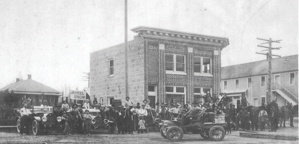
By the early 1900s, Eatonville’s expansion included the Tacoma-Eastern Railroad, which transported tourists to the Mount Rainier foothills. The area also relied on the railroad to transport lumber to market. Along with that economic expansion came the establishment of a local bank. In 1913, investors chartered the Eatonville State Bank. Ownership of the structure has only changed twice since 1913.
Italian immigrant Angelo Pecchia became owner of a small theater in Eatonville in 1922. In 1942, he and his wife, Regina, built the Roxy Theatre, and operated it until the 1970s.
In 2012, the community jumped in to assist in a fundraising effort to modernize the theater with new digital technology in order to keep the beloved Roxy open to the public.
When Thomas Cobb Van Eaton arrived to the area in 1889, his plan was to start a town. The first cabin, built the year he arrived, served as his home as well as a post office, trading post and stage stop for travelers passing through the area.
What was once known as the Tofu House has been relocated to this spot for preservation. It was the center of the Japanese mill community. However, shortly after the attack on Pearl Harbor, all Japanese descendants, including local mill workers, were suddenly relocated to internment camps further inland.